
frikadick
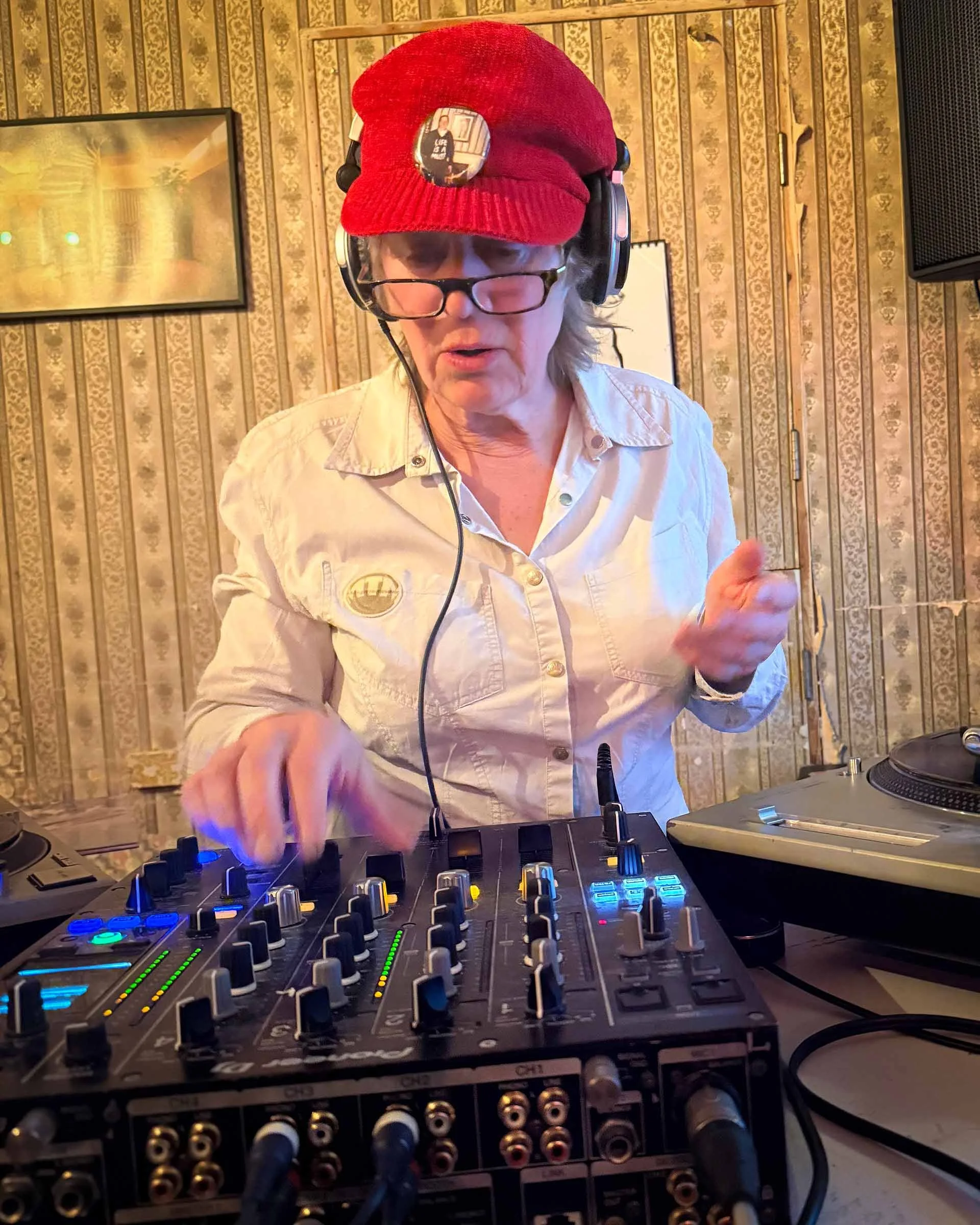
Frikadick made her Amsterdam Vinyl Club debut in May 2026, bringing an eclectic selection of sounds to the decks.
A visual artist and lifelong music lover, Frikadick sees records not simply as music, but as objects imbued with history, memory and human connection.
Frikadick played at Amsterdam Vinyl Club on:
Meet Frikadick on:
An interview with Frikadick
Tell us a little bit about yourself.
I’m a visual artist, and for most of my life I taught at an art college in Enschede, which I loved.
Now I’m at a stage in life where I have more time to branch out and explore other things.
Together with my husband, I’m also involved in building a foundation – partly to look after our work and archive in the future, but also to support artists working today. We’ve recently started an artist residency and are beginning to organise exhibitions and other projects.
So creativity has always been at the centre of my life, although it takes different forms.
What inspired you to play a DJ set?
Well, first I should say – I never really thought of myself as a DJ!
But my whole life I’ve been on dance floors, at concerts and around music. You see people behind the decks surrounded by knobs and machines and you start wondering how it all works.
And, if I’m being honest, I’ve also stood in crowds thinking, “What a terrible DJ – come on, we want to dance!” Not because I assumed I could do better – more because I wanted to understand the process for myself and see what it actually feels like.
How did you find your first experience behind the decks?
Very enjoyable – but I immediately discovered one essential piece of advice: please give DJs light!
I’d carefully written everything down beforehand, then suddenly found myself staring at dark labels with black text, wondering: Is this side A or side B?
Playing vinyl is harder than it looks. You think you have plenty of time between tracks, but suddenly those three or four minutes disappear very quickly.
Because it was my first set, I was concentrating so hard on finding records and keeping things moving that I barely looked at the audience. But I can already understand how experienced DJs react to the room and make decisions in the moment. That part fascinates me.
Your set was eclectic. Is your music taste equally wide-ranging?
Absolutely. I’m very much a child of the punk era in Britain during the 1970s, but also everything that came before and after. I’m open to almost anything.
Sometimes I regret not having explored certain musical directions more deeply, but perhaps that’s also part of the pleasure. There is always more to discover. That’s one of the beautiful things about music – it never stops expanding.
Has vinyl been a long-term passion?
Yes – although I’ve probably been buying more vinyl again in recent years. We also have plenty of CDs at home, but what matters most is the listening experience itself. We have a good sound system and enough space to really hear what’s happening in the music, and that feels like a luxury these days.
Compared with streaming, vinyl feels completely different. The sound itself is richer, warmer and more physical. But beyond that, vinyl asks something of you. You have to interact with it. You choose a record, put it on, listen, maybe decide it isn’t right and change direction. That creates a completely different relationship with music compared with something endlessly streaming in the background.
Do you have a large record collection?
About three metres of records! I’m not sure whether that counts as large or not. We’ve had to create a sort of auxiliary collection as well – some records live at our farmhouse in France.
Of course, that creates a new problem because sometimes you realise you want a particular record in the Netherlands and discover it’s sitting in another country. But that’s part of living with records.
What is it that attracts you to vinyl?
The sound, first of all. Really good sound. But also the physical experience. The sleeves, the artwork and the history attached to records also add flavour.
I recently bought an old Alice Cooper LP, ‘Billion Dollar Babies’, and just holding that snakeskin sleeve felt extraordinary. Records carry memories. My father, who was born in 1910, loved ‘School’s Out’, and seeing albums like that immediately connects me to people and moments from my own life.
Streaming gives recognition – “Oh yes, I know this song!” – but much of the history and context disappears. Vinyl keeps those things alive. And records are social. People share them. They become part of conversations and friendships.
When I was younger, if you went home with somebody, the first thing you did was look at their record collection. Then their bookshelves. If they had no bookshelves… you ran!
Are there any holy grail records you’re still searching for?
Not really. I don’t collect in that completist way. I’m more interested in discovery. At the moment I’m exploring dub – especially late-70s and early-80s dub – and thinking about how extraordinary those recordings were from a technical point of view. No computers, no digital tools – just imagination and mechanical ingenuity.
So I tend to follow ideas and sounds rather than chase specific trophies. That feels more exciting to me.