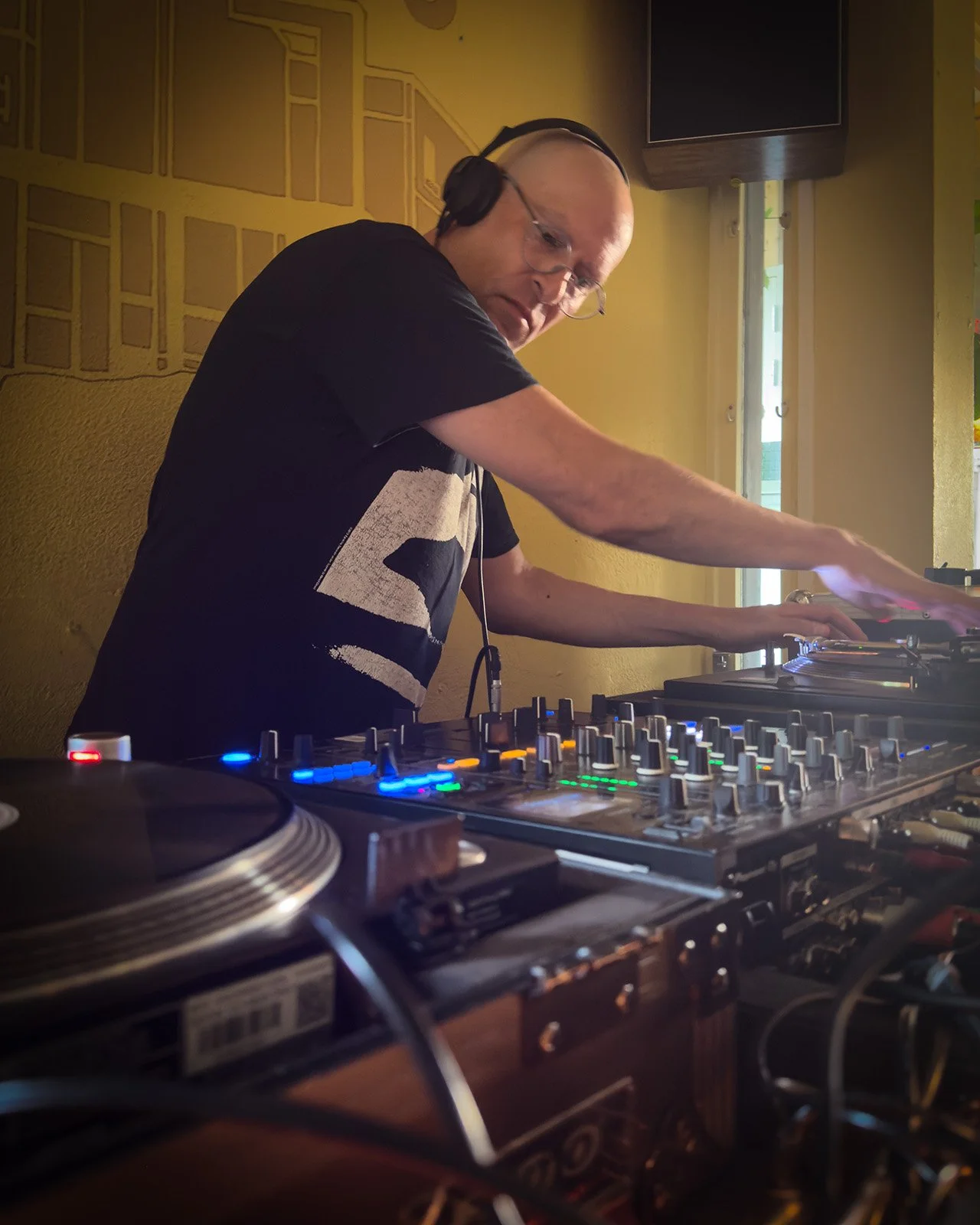
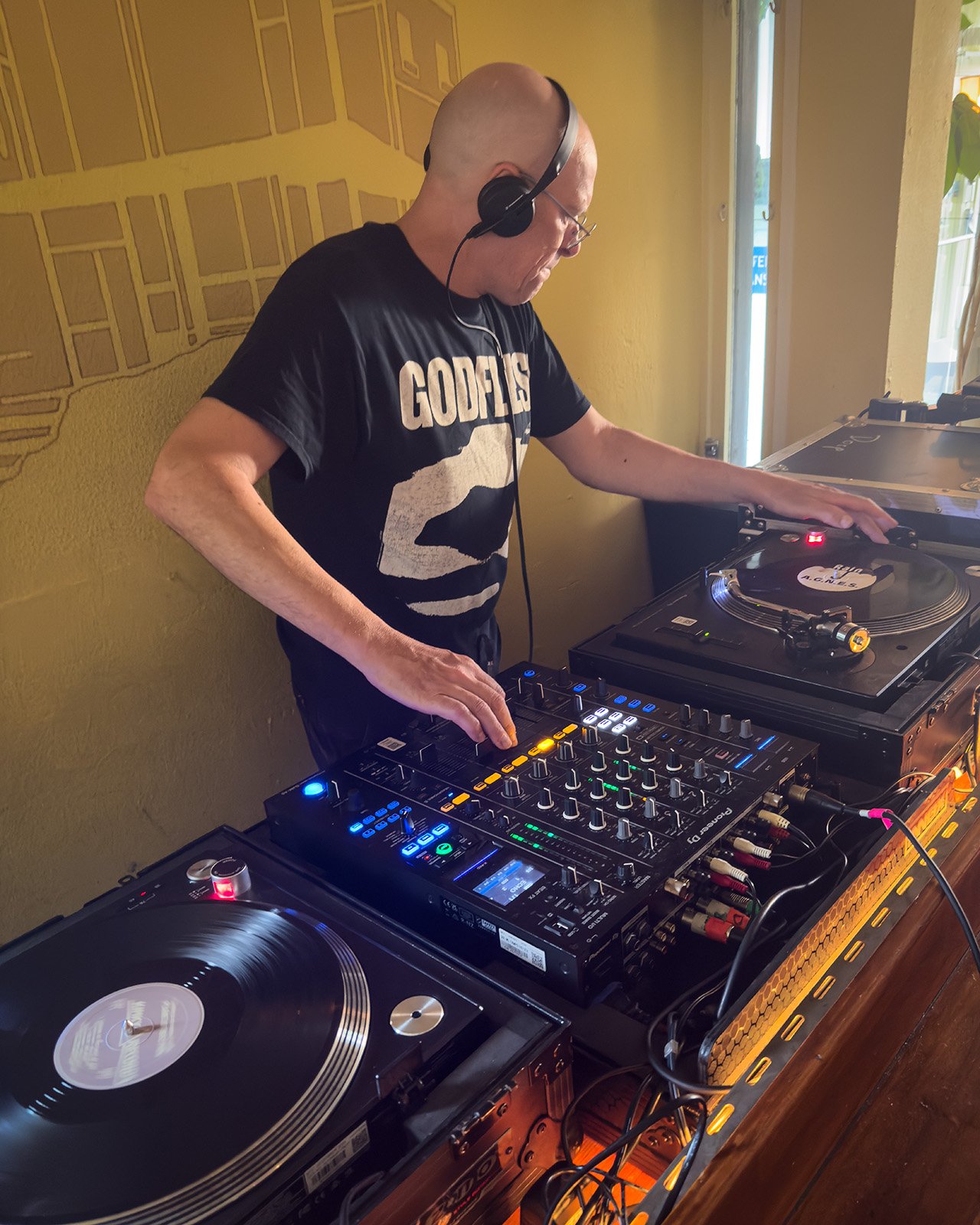
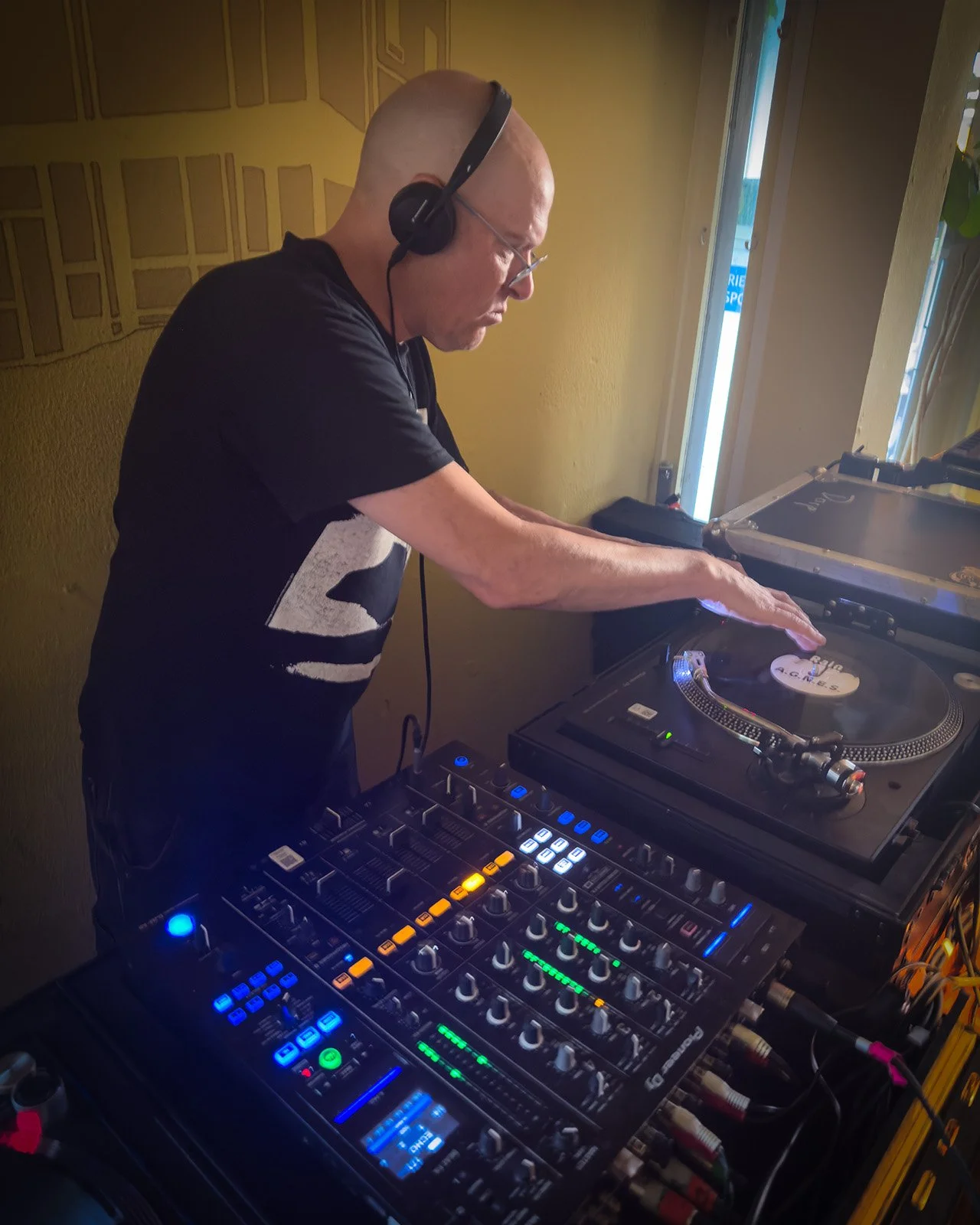
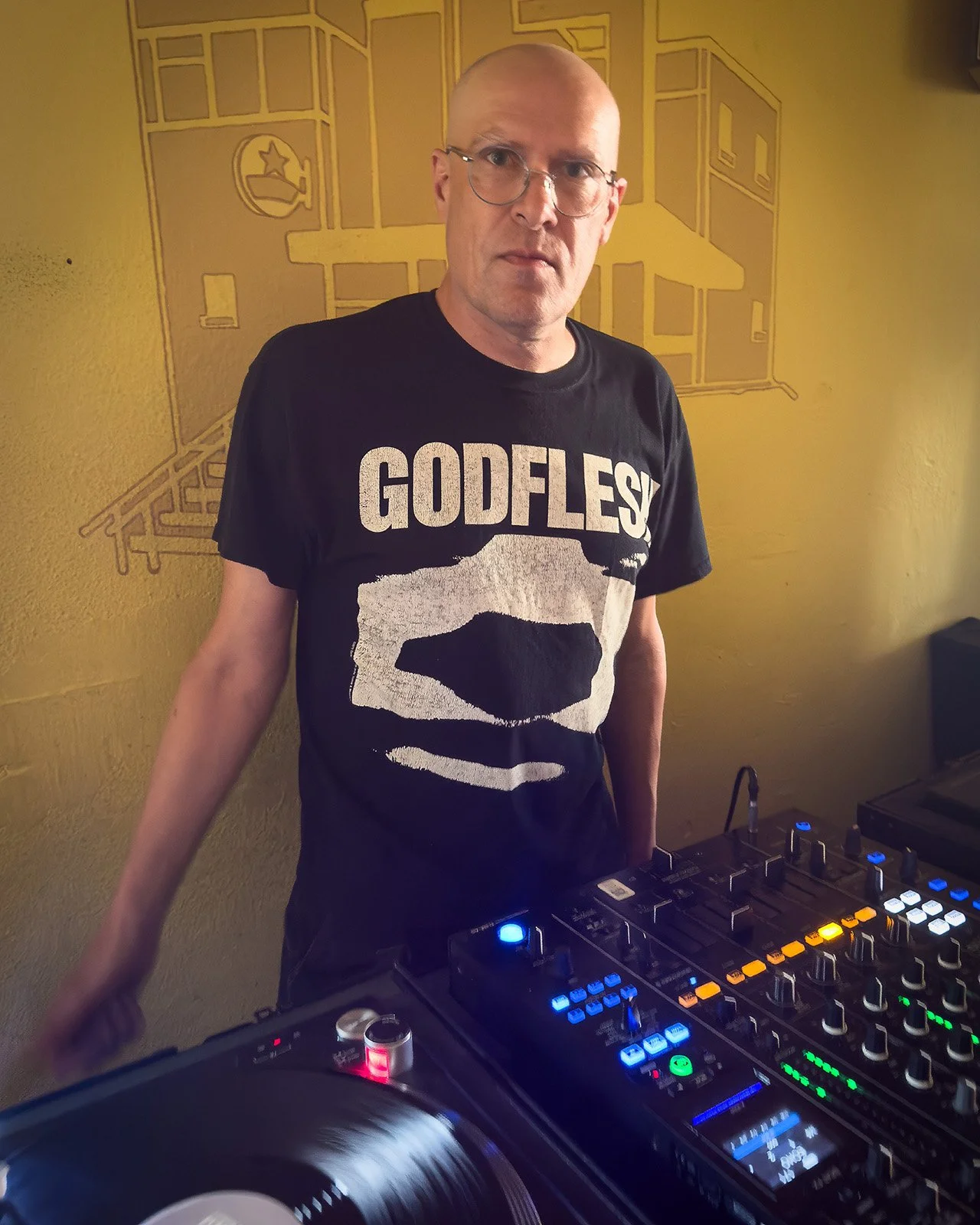
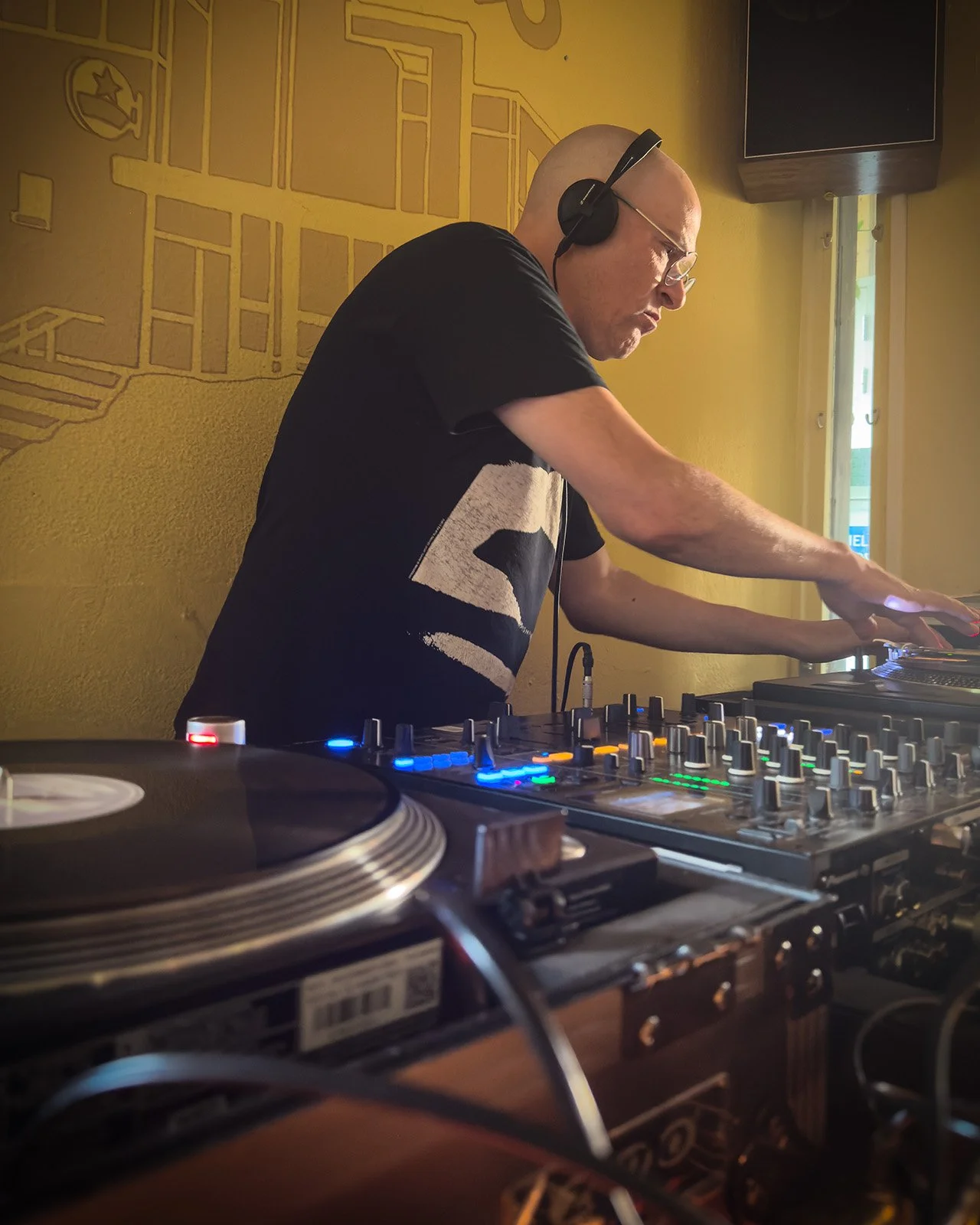
DJ glenn (strobelight_funeral)
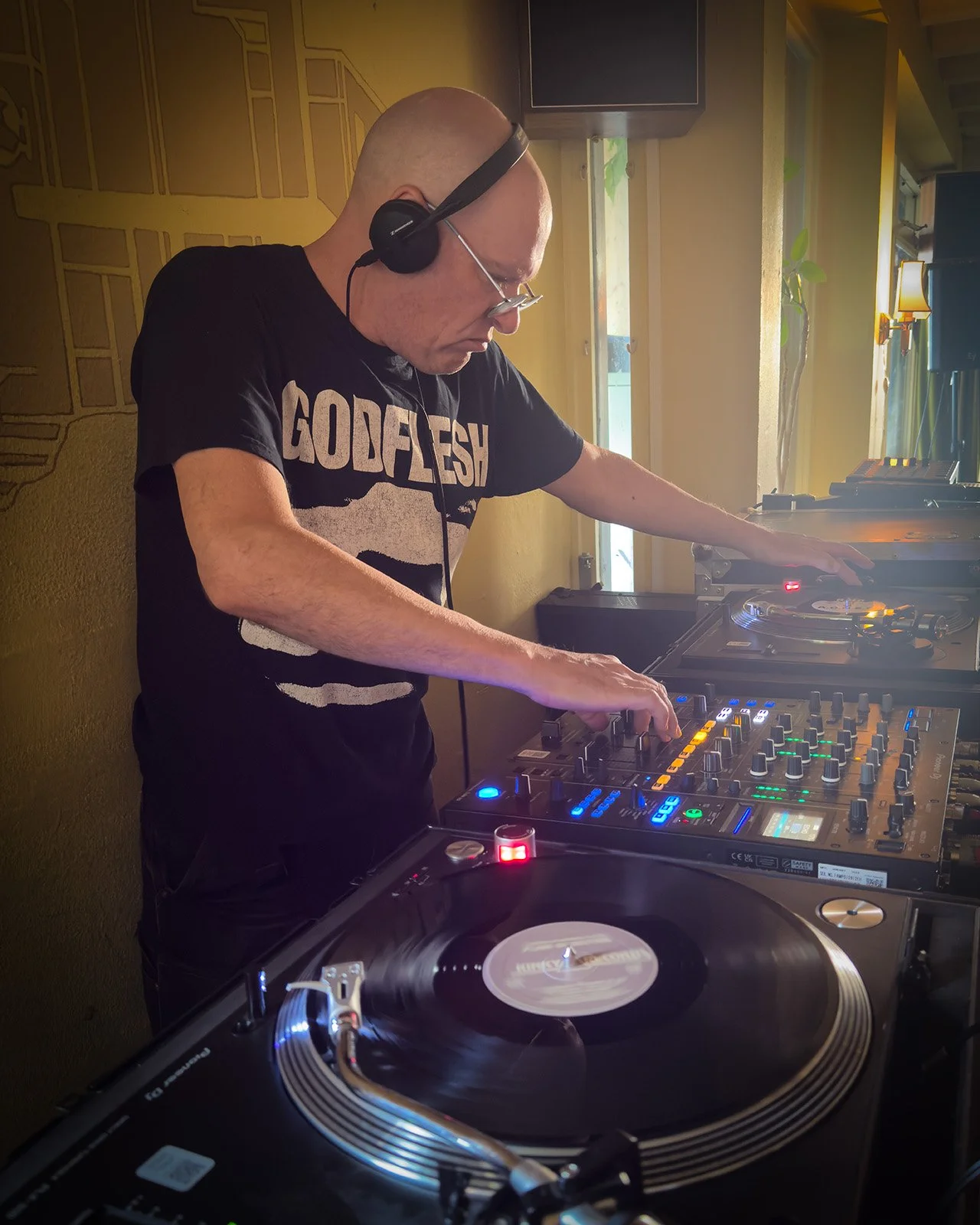
DJ Glenn (strobelight_funeral), has spent more than four decades playing music, collecting records, performing in bands and exploring underground sounds.
Shortly after moving from the New York area to the Netherlands, he joined us at Amsterdam Vinyl Club to share some records from his enormous collection.
We spoke to DJ Glenn about discovering hip-hop, punk, dub and electronic music in the 1980s, his years organising parties in New York, and his decision to start a new chapter in Amsterdam.
DJ Glenn played at Amsterdam Vinyl Club on:
30 July 2026
Check out DJ Glenn’s band, Tiers, on Spotify.
An interview with DJ Glenn
Where did your musical journey begin?
I’ve been into music for my entire life. I grew up listening to Van Halen in the 1980s, and my first concert was Van Halen in 1982.
Van Halen and Rush inspired me to teach myself how to play drums on cardboard boxes. I eventually started playing in bands when I was around 16, and I’m 55 now – so I’ve been playing drums for a long time.
What other music were you discovering while growing up?
I grew up in Connecticut, where we could pick up New York radio stations. That exposed me to early hip-hop, back when people generally referred to it as rap.
I always wanted to find the thing that nobody else around me was listening to. That led me towards punk, and there was also a radio station that played dub. I was listening to all sorts of different things: early hip-hop, dub, Depeche Mode and music connected with breakdancing.
It was a complete mishmash, and it still reflects the way I listen to music today.
Things developed naturally from there.
When did you begin collecting records?
I’ve collected vinyl for almost my entire life. Records were always part of how I discovered and experienced music.
When I moved to New York in 1990 and started going to clubs, places such as the Limelight opened up an entirely new world of electronic music for me.
How did you first start DJing?
A friend of mine was DJing during a cocktail or happy hour at a bar, and he’d play things such as English Beat and Kraftwerk.
That made me realise DJing didn’t always have to be about playing huge dance floor fillers. You could put records together almost like you were making a mixtape.
I DJed with him once, then started getting into techno, beatmatching and playing at techno parties.
How did that develop into organising your own parties?
Three friends and I all ended up at the same DJ night after seeing a flyer for it. The night was called FAC 215, after a Factory Records catalogue number.
The DJ was a French guy who later became a friend of mine. He introduced us to French coldwave and other music that was almost impossible to find in America at the time.
We became obsessed with hunting down records on eBay. We’d sometimes coordinate our bidding so that one of our friends had a better chance of winning a record. It became a kind of record-buying mafia!
The French DJ and I eventually started our own party, which became quite successful. It was a little more commercial and dance-oriented.
You were also involved with a long-running underground night in New York. What was that like?
Another friend and I started a party called Wierd. It ran on Wednesday nights for around 15 years.
The parties would carry on until four in the morning, which was difficult when I also had a nine-to-five job. There were many sleepless nights and plenty of mornings when I turned up at work smelling of cigarettes, but I’m still alive!
How did New York feel after that party ended?
When the party finished, it felt as though a cultural line had been drawn. I’m sure there were still underground things happening in New York, but there wasn’t much that felt intended for people our age or connected with the music we loved.
The New York I’d originally moved to didn’t seem to exist any longer. Things had started to feel a little bland.
My wife, Jennifer, and I moved to New Jersey. We had turntables and thousands of records, so during the pandemic we would DJ for each other at home.
When you’re married to somebody who loves music, you’re essentially DJing for them anyway. You want to keep that one person happy.
What brought you and Jennifer to Amsterdam?
After nine years in New Jersey, we sold our house, packed everything up, and moved to Amsterdam.
We only knew a few people here, so we’re still finding our footing. Being invited to play at Amsterdam Vinyl Club has helped me feel that I’m beginning to find a musical community, so I’m very grateful for the opportunity.
Amsterdam feels welcoming and diverse. People seem to look out for one another. It feels less like a society based entirely on taking and more like one based on give and take.
There are rules and a sense of etiquette. Even when you’re cycling, you feel as though everybody understands how the system is meant to work. I actually feel like I’m living in a society.
Was moving to Amsterdam also about changing your way of life?
Yes. I’d never previously lived more than two hours away from where I grew up.
I toured around the world with bands, but I always had a job and a backup plan waiting for me when I returned. I’ve done what society expects of me for a long time.
Both Jennifer and I are graphic designers – but, as I got older, working in the media industry became increasingly difficult.
Eventually, we thought, “Let’s do this for ourselves and live life on our own terms.” There comes a point when you have to follow your dreams.
Are you still making music with a band?
Yes, I have a band called Tiers. All our equipment is being shipped over, and we’re finishing our second album.
The music is somewhere between shoegaze and electronic music, with influences such as Ride. We’re hoping we can continue making music here on our own terms.
How many records do you have?
Probably around 5,000.
When we lived in New Jersey, we had a room built over a two-car garage. The record room was on a concrete slab, so there was no vibration when we played music, and the neighbours couldn’t hear anything. It was a brilliant space.
Most of our collection is currently being shipped to Amsterdam. I brought all my records worth more than $100 with me as hand luggage, because I couldn’t face putting them on a boat.
That meant my selection for the AVC set was slightly limited, but I think I managed to pull together a good set.
Has it been difficult living without your collection?
I didn’t realise I would go for two months without listening to records. We don’t even have a working turntable here yet, and I’m becoming very restless.
I found a turntable in the trash, but it was designed to connect to a particular component system, and I haven’t been able to get it working.
But I’ve been finding music and putting together selections on YouTube instead. When all our records and equipment finally arrive, it will be exciting – although probably a little overwhelming too.
Is there a record you regret letting go?
There’s one industrial record that I originally bought for a dollar. At the time, it wasn’t useful to me and wasn’t really my thing, so I traded it for a record that I badly wanted, which was worth around $100.
I later discovered that the record I traded away was worth around $500. Discogs didn’t exist at the time, so I had no way of knowing. I’d quite like to have that one back.
Are you prepared to spend large amounts on records you want?
Not really. I don’t think I’ve ever spent more than $100 on a record.
For me, the pleasure is more in the chase than simply owning something. I like to believe that the records I want will eventually find their way to me.
A record doesn’t feel as precious when you can just go online and empty your savings to buy it. I prefer discovering something unexpectedly and feeling that it has become part of my history.
Has moving to Europe changed the way you buy records?
Shipping records in America has become very expensive. Sometimes the postage will cost twice as much as the record itself.
I’m enjoying the European shipping costs. Here, you can buy a €5 record and pay less than €10 to have it delivered. In America, that same $5 record might end up costing you $50.
Those small differences make collecting much more enjoyable.
As a graphic designer, what attracts you to vinyl as an object?
I’ve worked in record design, and I still design record covers. For me, the printed object is a huge part of the experience.
When I was growing up, I’d take a record home and pull everything out of the sleeve. The more things that were inside, the better – inserts, catalogues, order forms and anything else the label had included.
You could study the credits, discover who produced the record, find out which drum machine they used, and absorb all the details around the music.
When I design a record, I often like to have the sleeve printed inside out so that you feel the rough side of the paper. Labels such as 4AD set the standard for album design because they treated the visual and audio elements as one complete experience.
Vinyl is about much more than listening. It’s a 360-degree experience.
Why do you prefer DJing with vinyl?
DJing without vinyl makes me nervous.
When I’m playing records, I can flip through the sleeves and immediately remember that the track I want is the second song on a particular side. I know where everything is.
There’s a kind of muscle memory involved. You pull out a record, handle the sleeve, find the track and put it on the turntable.
When I’m using software, I have to think much harder about where everything is. With a laptop, you can start a track and then simply stand there waiting for it to finish. With vinyl, the physical process is part of the performance.
The covers, the artwork, the credits and the ceremony of playing the record all belong together. I’ve owned CDs and cassettes, but I’ve never felt as attached to music in those formats as I do to vinyl.