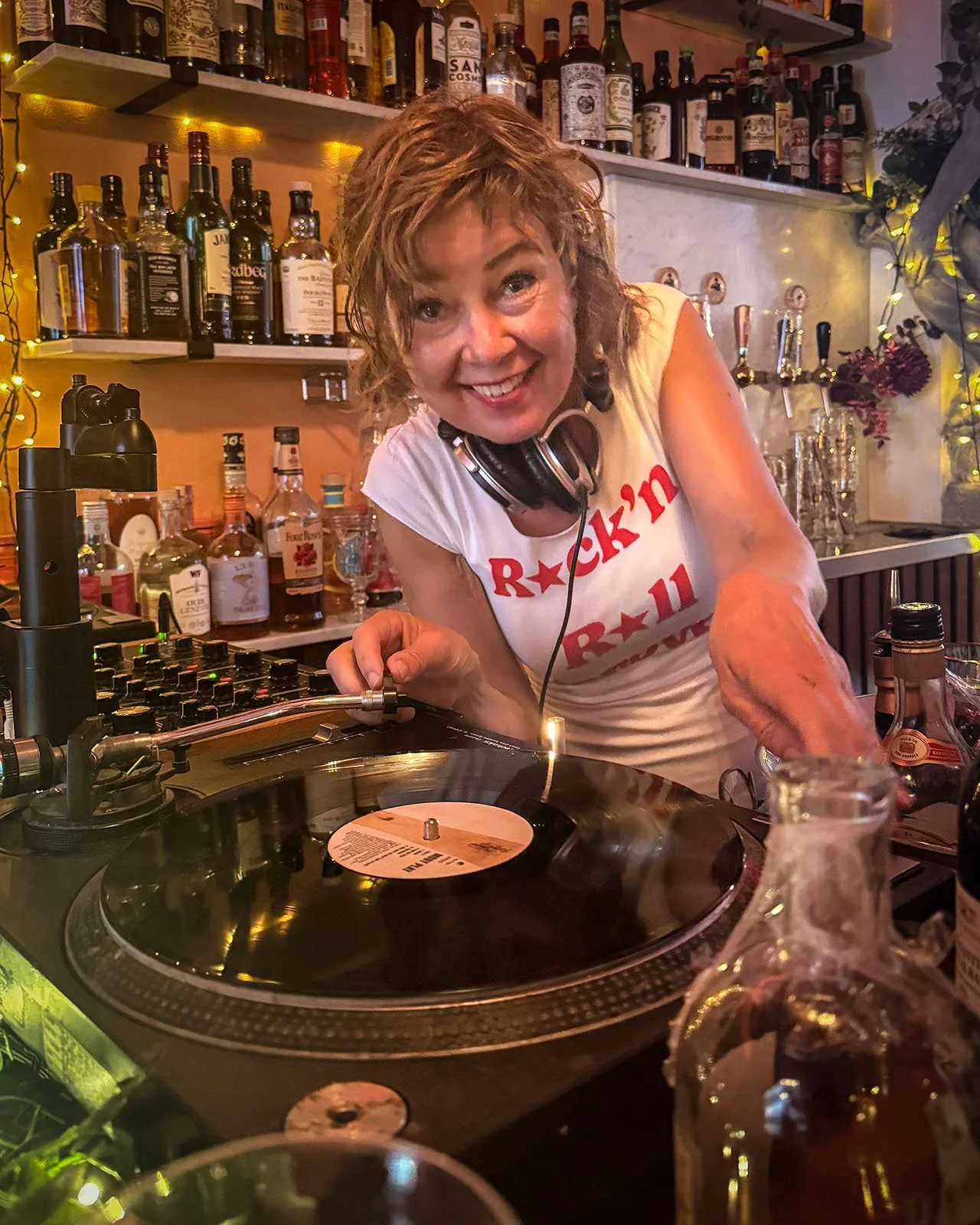
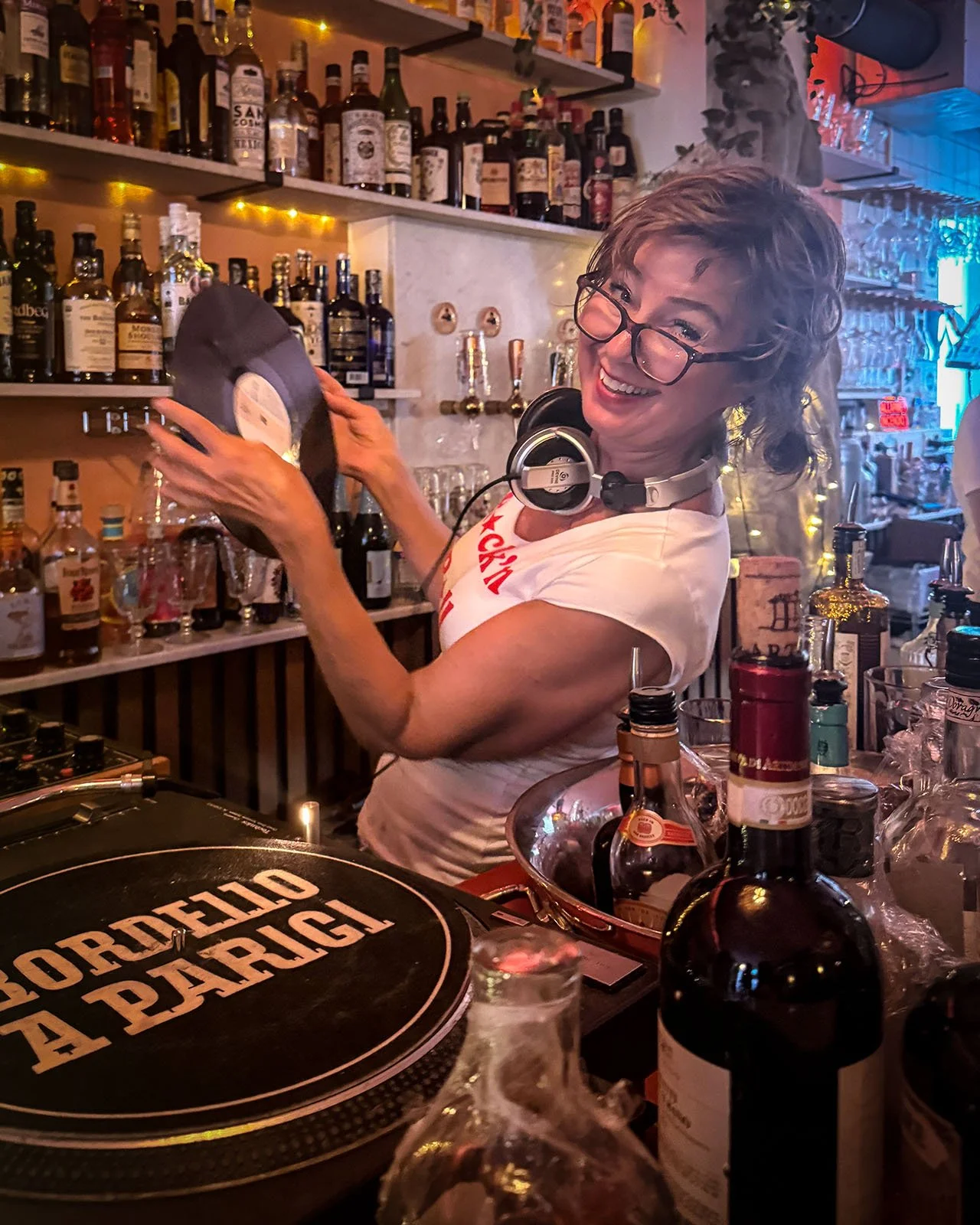
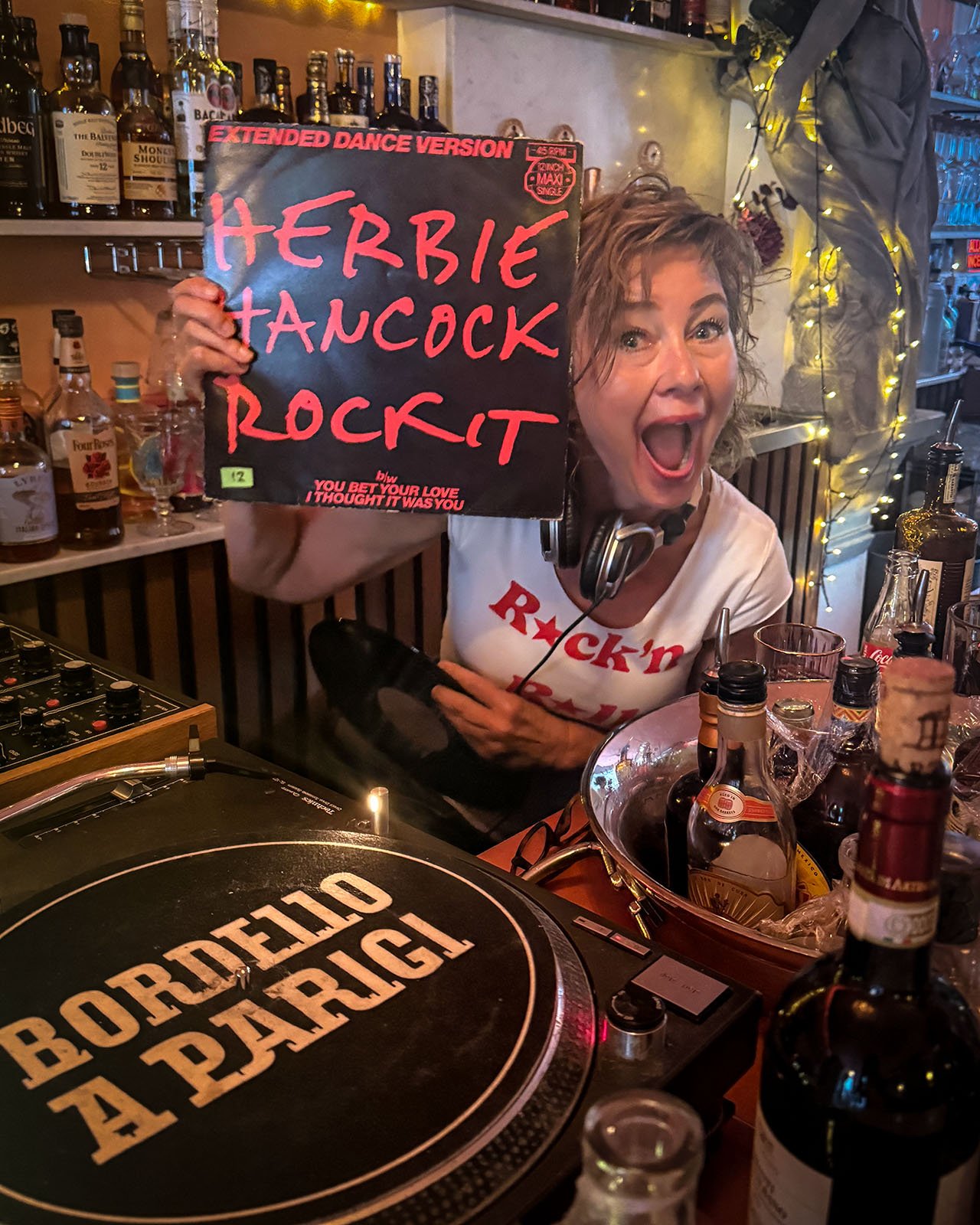
DJ FORTUIN
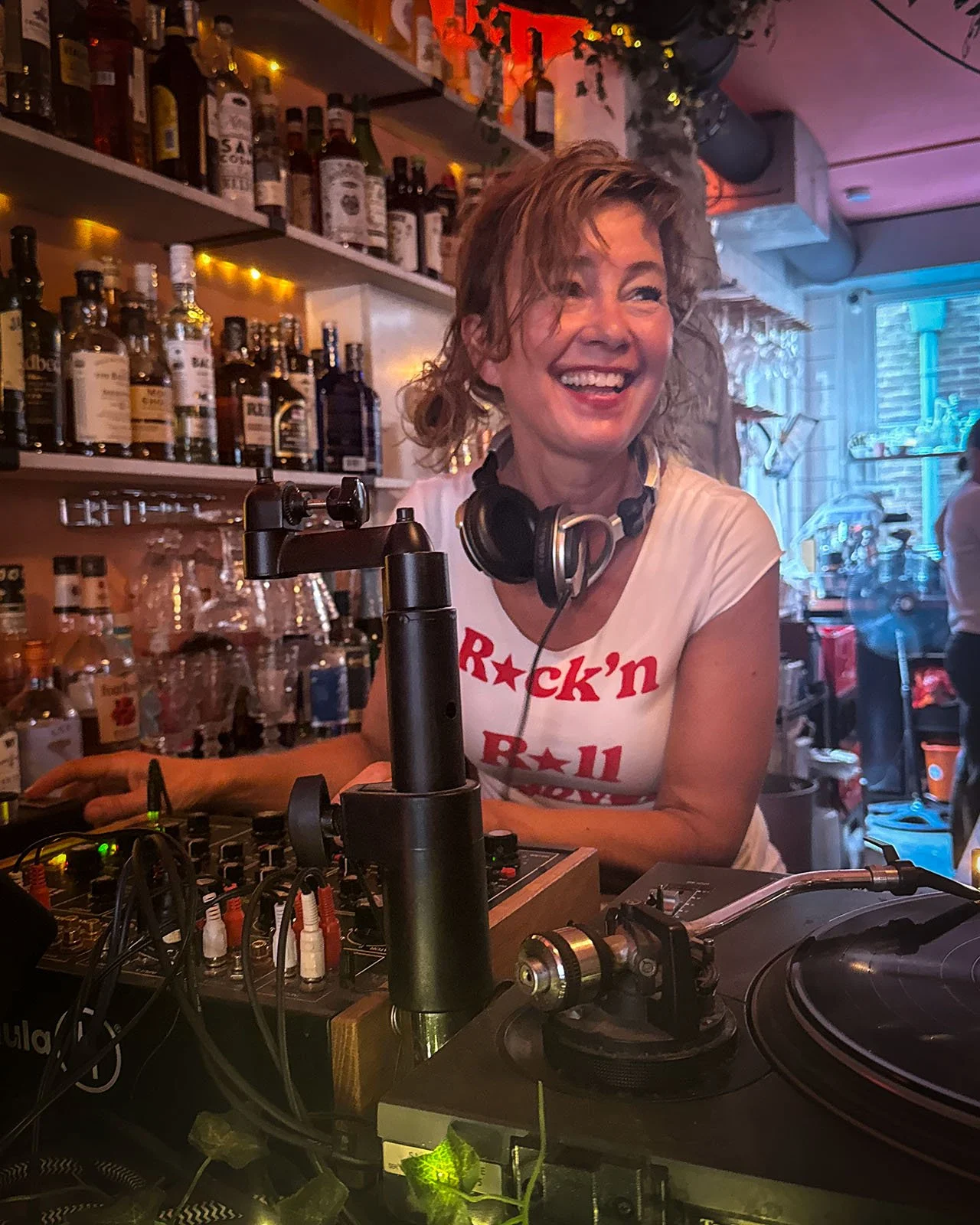
DJ Fortuin’s musical journey began not behind the decks, but through art, film and visual projections at Amsterdam club nights in the early 1990s.
We spoke to her about discovering DJing by accident, reading the energy of the dance floor, and how music and dancing allow her to live in the moment.
DJ Fortuin played at Amsterdam Vinyl Club on:
Meet DJ Fortuin on:
Instagram: @laura.fortuin
her website: Djfortuin.nl
An interview with DJ Fortuin
First, tell us a little about yourself.
I was born in Italy, but my family moved to the Netherlands when I was five. My father found work in Eindhoven, so I grew up in the south of the country.
When I was 18, I moved to Amsterdam to study at the Gerrit Rietveld Academie, and I stayed here after graduating.
I trained as a painter and also worked with film and photography. I did many different creative things before I started VJing and DJing.
How did you first become involved with Amsterdam nightlife?
In the early 1990s, I started creating decorations for large house parties such as Timemachine at Melkweg.
I made slideshows and projected pieces of film in one area of the venue. There wasn’t any music in that particular space, so I thought, “If there’s no music, I’ll have to play it myself!”
That was how I began DJing. It wasn’t my intention to become a DJ. It simply happened out of necessity, and then I embraced it.
Where did you play during those early years?
After that, I began playing in some of the smaller rooms at venues such as Paradiso and Melkweg.
I loved those spaces. They weren’t the main halls, but they had their own atmosphere, and that was really where DJing began for me.
Then I became a mother, and music took more of a back seat for a while. Around ten years ago, I picked it up again.
Since then, I’ve played at smaller events and private parties, as well as occasionally returning to larger venues.
What does DJing give you personally?
DJing is a happy space for me.
There are always difficult or annoying things happening in everyday life. You receive a letter from the Belastingdienst, or there’s something else you have to deal with. DJing takes me away from all of that.
But it’s also a reality of its own. When I’m playing, I’m completely in the here and now. That gives me a lot of joy, and I think people can probably see and feel that.
There’s a strong sense of joy in the way you perform. How important is a DJ’s personality?
For me, DJing isn’t just about the music. It’s all about energy. The person behind the decks also brings something to the experience.
It isn’t about showing off or saying, “Look at me!” It’s about the energy you create with the people around you.
Do you have a large record collection?
It isn’t enormous, although I wish I had more money to buy more records!
I have a lot of older music, and my collection of newer releases is gradually growing too.
I mostly play vinyl, although I also use my laptop. I’d love to play everything on vinyl, but it can become very expensive.
What is it that you love about vinyl?
It begins with the sleeve. Vinyl is something you can see, hold and touch.
When I search through music digitally, everything feels so small. I often get annoyed trying to find things on a screen.
Vinyl is physical, and the sound is different. To me, it feels warmer.
Younger people sometimes look at a record and think, “What is this?” Then they discover it and realise how exciting it can be.
Does playing vinyl require a different kind of attention?
Yes, it takes more effort.
With digital DJing, some parts of the process can happen automatically. With vinyl, you really have to listen.
I’m not the princess of beatmatching, but I’m still learning. You have to pay close attention to what the records are doing, and I like that.
How would you describe the music you play?
In a single night, I might go from 1960s ska to contemporary house, with all sorts of things in between.
I don’t play much heavy metal, although I once played at a private party for someone who was in a metal band, and I had a lot of fun. I might also play punk or anything else that feels right at a particular moment.
What matters most is seeing what works with the audience. People sometimes tell me that I can feel the dance floor, and that’s what I enjoy most.
How do you read a dance floor?
I don’t want to be the kind of DJ who’s only interested in herself. The people on the floor and I are making the party together.
Sometimes it’s hard work, and sometimes everything happens easily. It depends on the weather, the time, the venue, the people and the atmosphere.
Every party is different, so I try to remain open to what’s happening.
Do you prepare your sets in advance?
I gather together some music beforehand, but I don’t create a set that’s completely fixed.
I want it to remain open. I might take out a record, listen to the moment, and decide to put it back again.
I want my sets to be open because I want life to be open. I want to remain open myself, and I would like other people to open up too.
Where else can people hear you play?
I play around four times a year at Arti et Amicitea and Bij Bind, a lovely little place on the Hembrugterrein in Zaandam.
The next event there is on October 9. After a funky electro band, Reborn Bliep (friends of mine), the dancefloor is ours. Info will follow soon.
Soon I’ll also spin at the restored Buurtboerderij Ons Genoegen, and occasionally I play at Paradiso’s Parafanalia Vintagemarkt (vintage market).
Those nights feel like my own events. People come there specifically to dance, which makes them very enjoyable.
I also sometimes play with the Random Vinyl Club. During Amsterdam Dance Event, they organise a marathon with DJs playing vinyl continuously from the beginning of ADE until the end.
(You can see the Random Vinyl Marathons DJ Fortuin played at:
She also played a vinyl-only 60 minute set for Random Vinyl Micro Marathon March Edition 2026.)
Much of my other work is at private events, such as birthday parties for people turning 30, 40 or 50, at venues like Hotel Arena, Blauwe Theehuis, PLLEK, Pingpongclub, Karma Kebap, Kookfabriek (all Amsterdam), Oase (Rotterdam).
Dancing is also a big part of your Instagram. How did those videos begin?
I love dancing. It gives me energy, and I think that energy can be contagious.
The videos began a few years ago with my boyfriend, who’s very good at filming. When we were travelling, he’d encourage me to dance somewhere, perhaps beneath a waterfall or in front of a beautiful landscape.
The films are very simple. You see the location, and then you see me dancing in it.
What do those dancing videos represent to you?
They’re about being yourself and not worrying about what other people think.
Sometimes people look at me as though they’re wondering what I’m doing. Then a child might point and say, “Look, she’s dancing!” and start smiling and dancing too.
That’s what it’s about. Life can actually be simple. It’s about energy and being comfortable enough to express yourself.
The videos feel very natural rather than staged. Is that important to you?
Very important. I dislike social media images that feel fake.
I hope I never lose a sense of purity. I don’t dance because I want to show off. I do it because I genuinely want to dance.
That’s also how I approach DJing. I want to enter a flow rather than manufacture something that doesn’t feel real.
What do you hope people receive from your music and your dancing?
I’m happy when something I do makes another person happy.
It might only add a small twinkle to somebody’s life, but that still matters. I want it to be an honest twinkle, not something staged.
Perhaps that’s my purpose: to create little moments of joy.
Is there a record you would particularly like to add to your collection?
One record currently on my list is ‘Clap Clap’ by Anunaku & DJ Plead.
It has an Eastern influence, but it’s also housey without being too heavy or repetitive. It’s the kind of record that makes me happy, and I’d love to find it on vinyl.